
Midlands Province Profile
Facts and Figures
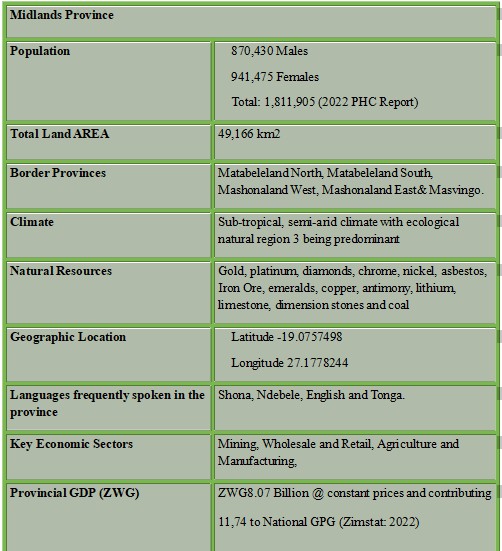
There are 8 administrative Districts in the Province namely Chirumhanzu, Gweru, Gokwe North, Gokwe South, Kwekwe, Mberengwa, Shurugwi and Zvishavane. Within the cited 8 Districts are 8 Rural Local Authorities and 6 Urban Local Authorities. Consequently, the Midlands Province has a Strategic Plan synchronised with the Provincial Economic Development Plan (PEDP) in order to leverage on the province’s resource endowments including synergies with various stakeholders
- Endowed with a variety of wildlife, leisure and scenic places
- The district covers 49,166 km² and home to 1,811,905 people (2022 Population and Housing Census)
- Serves as a major trade and industrial hub for ferrochromium, footwear (home to the historic Bata Shoe Company), and dairy processing.
- Surrounded by rich mineral deposits including chrome, gold, iron, and asbestos.
- Skilled and diverse human capital.
- Hosts the key Gweru-Thornhill Air Base training facility for the Air Force of Zimbabwe
- Home to Midlands State University, one of the country's largest tertiary institutions.
- Noted for the Gweru Military Museum and nearby Antelope Park, a prominent wildlife and lion conservation sanctuary.
- Popular plants grown in Gweru include staple field crops like maize, resilient green leafy vegetables such as rape, covo, and spinach, and commercial horticultural produce like tomatoes and cabbage.
- The surrounding area has rich deposits of gold, chrome, iron, asbestos and platinum and supports several mines.
- The surrounding area has rich deposits of gold, chrome, iron, asbestos and platinum and supports several mines.
Some of the best places to visit in Midlands Province
- Bindura is a tourist destination, however with Acadia Dam being not too far away, it is a draw card to the area. There are camping sites, chalets, ablutions and braai facilities for overnight stays, too. Visit Paradise Pools at the dam for a day filled with sun and relaxing.
- Why visit us:
- Gweru District features over 100 formal learning institutions split across its urban and rural zones
- The natural landscape of Gweru is defined by the gently rolling Highveld savanna, open grasslands, and peaceful river ecosystems
- Beyond the open plains, the overall scenery of Gweru seamlessly blends unspoiled African bushveld, tranquil river walks, and colonial-era architecture
- Gweru has a rich cultural heritage shaped by pre-colonial kingdoms, diverse ethnic groups including the Karanga and Ndebele, and colonial history
- Gweru has become a busy trade centre with some industrial development
- Its products include ferrochromium, textiles, dairy foods, footwear, and building materials.